01The Physical Reality of Disconnected Internal Contours
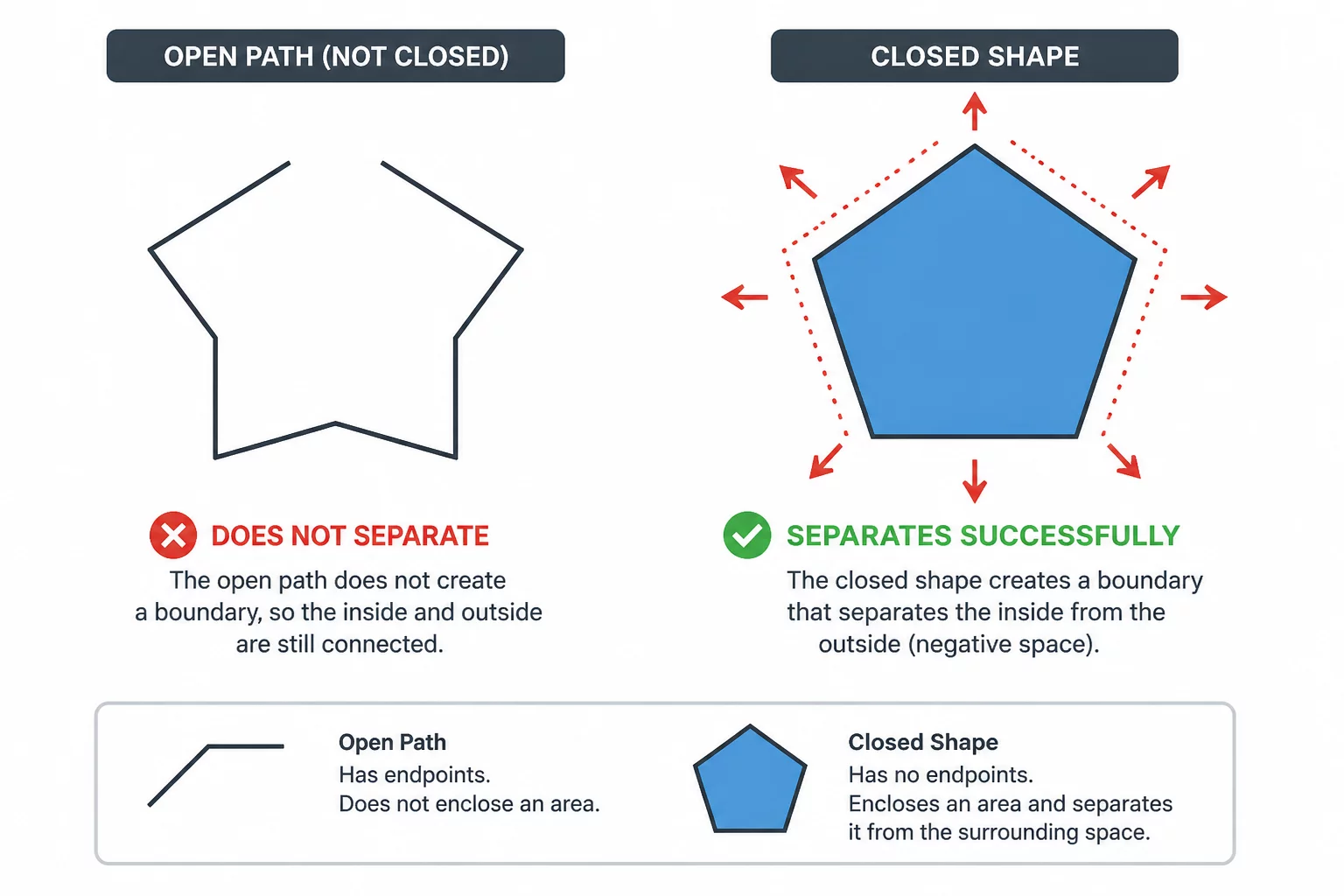
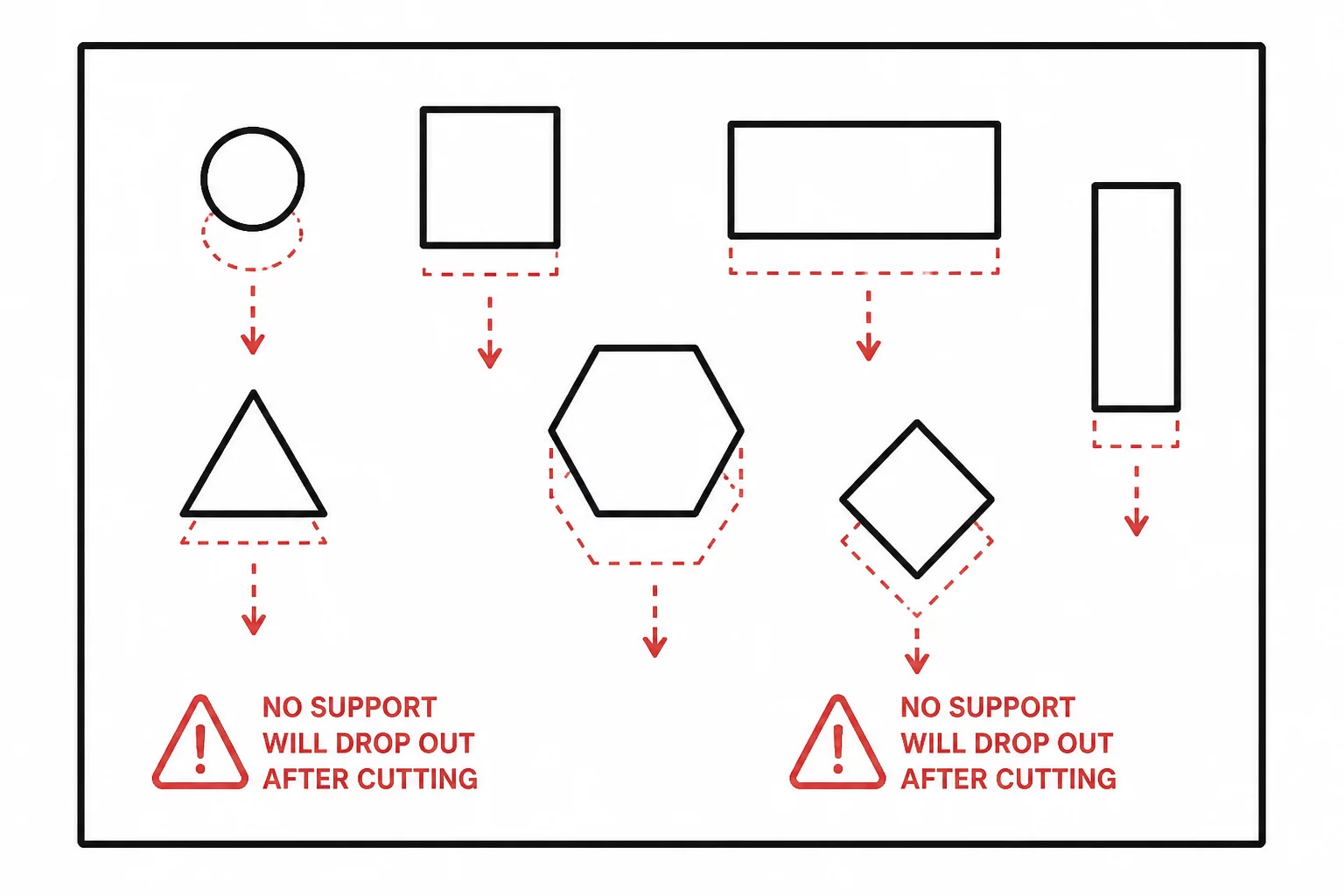
Vector drawing programs allow shapes to exist purely as abstract visual coordinates. A designer can place a small circle inside a larger ring, render it on screen with contrasting colors, and admire the composition. The physical blade, however, operates strictly on boundary separation. Once the cutter completes an enclosed path around an internal shape without a physical connection to the outer perimeter, that piece completely detaches from the surrounding substrate.
This condition creates what cutting engineers refer to as floating elements or islands. In adhesive vinyl cutting, islands remain firmly positioned on the backing paper until manual weeding occurs. In contrast, when slicing cardstock, stencil mylar, wood veneer, or sheet metal, every unanchored internal piece immediately falls through the cutting table into the collection tray, irreversibly destroying the intended graphic silhouette.
Key Takeaways
- Unbridged internal closed paths fall out instantly in self-supporting sheet media like cardstock or stencil film.
- Adhesive vinyl relies on carrier liner retention, requiring specific weeding sequences to prevent tiny islands from lifting.
- Structural bridge widths must be calculated based on material tensile strength and blade cutting kerf.
02Bridge Geometry vs Carrier Film Transfer Mechanics
Managing floating internal elements requires choosing between two production paradigms: mechanical bridging or adhesive carrier retention. Mechanical bridging involves physically connecting the internal island to the surrounding framework by slicing small relief channels through the perimeter. Carrier retention relies on the substrate adhering to a transfer liner during cutting, maintaining the coordinates until application tape secures the entire graphic assembly.
A vector line on a screen is a mathematical boundary, but in sheet production, every closed curve represents an irreversible physical separation.
When designing stencils or suspended papercraft, bridges are non-negotiable. The width of these bridges directly influences both structural durability and aesthetic cohesion. If a bridge is too thin, the rapid velocity of the plotter blade will tear the connecting tab; if too thick, the intended letterform or icon loses visual clarity.
03Calculating Tab Dimensions and Placement Strategies
Placing micro-bridges into vector artwork demands systematic path manipulation rather than arbitrary eraser strokes. Effective bridge placement anchors the island at its stiffest geometric points while preserving critical visual curves:
- Identify natural optical axes along straight segments rather than apex points to place micro-tabs without distorting curve curvature.
- Maintain a minimum bridge width of 0.8 mm for 65 lb cardstock and at least 1.2 mm for 7 mil mylar stencil sheets to prevent tensile failure during handling.
- Utilize Boolean subtraction with precise rectangular keyways across overlapping compound paths rather than open stroke cuts to keep perimeter nodes closed.
Boolean subtraction produces clean, closed boundary loops that cutting plotters can trace without stuttering or dragging the blade tip through open endpoints.
04Weeding Tactics for Microscopic Floating Features
In multi-layered vinyl decals, tiny floating islands—such as the centers of letters like 'e', 'a', or decorative stippling—often lift prematurely during high-speed cutting passes. The drag resistance of the blade tip against adhesive friction can dislodge small unanchored shapes before the job finishes.
To mitigate premature lifting on vinyl without adding bridges, optimize the cutting order to slice internal islands prior to cutting the exterior perimeter. Lowering the plotter's travel acceleration and applying slight negative blade offset keeps delicate islands seated firmly against the silicon release liner.