01The Physics of Dropped Counters in Cut Typography
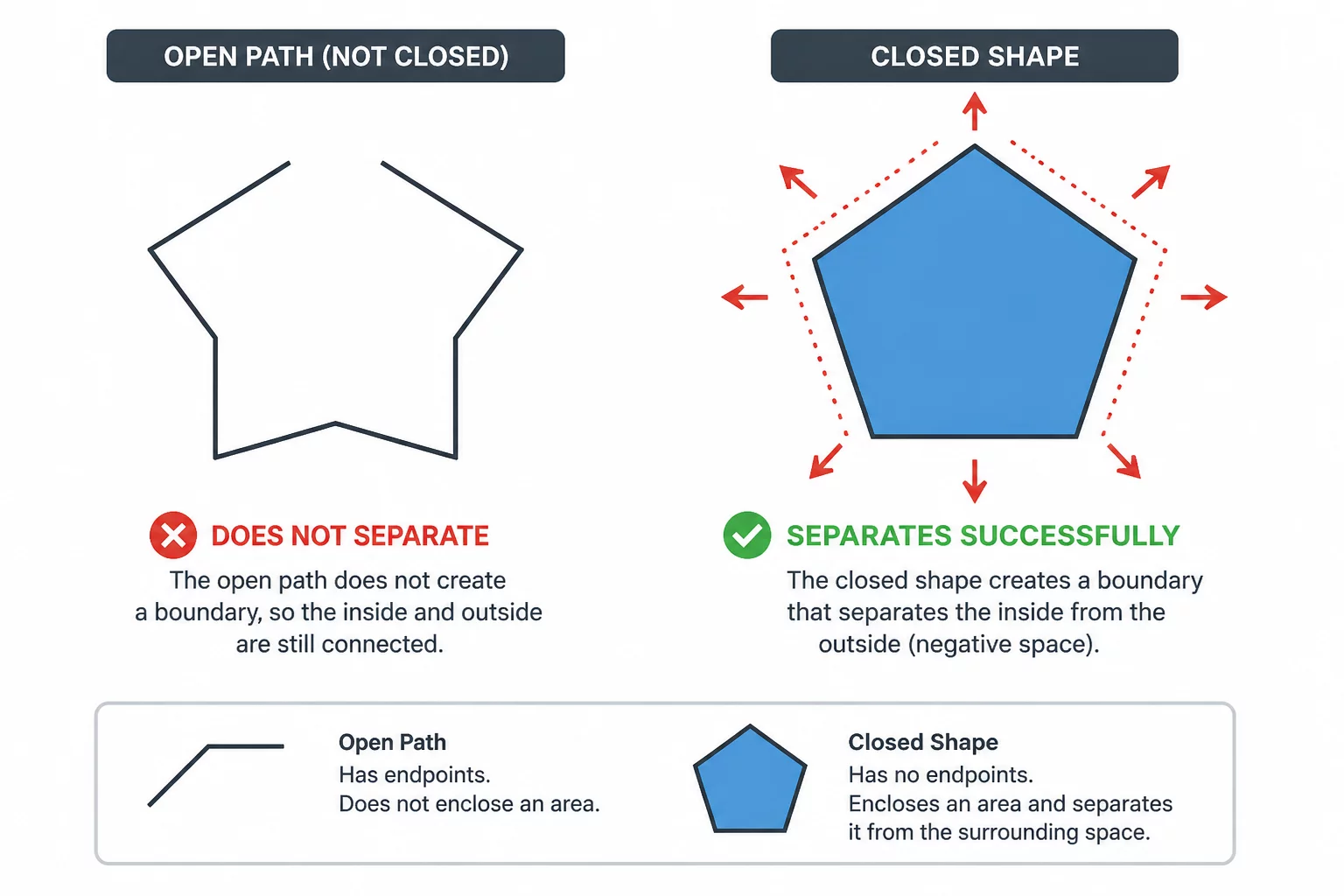
Standard typography relies entirely on optical contrast between dark ink and light substrate. When transforming digital font contours into physical cutout templates, letterforms with fully enclosed inner cavities—such as A, B, D, O, P, Q, and R—encounter an unavoidable mechanical failure. The plotter blade cuts both the exterior perimeter and the interior counter loop, severing the central island completely from the surrounding material framework.
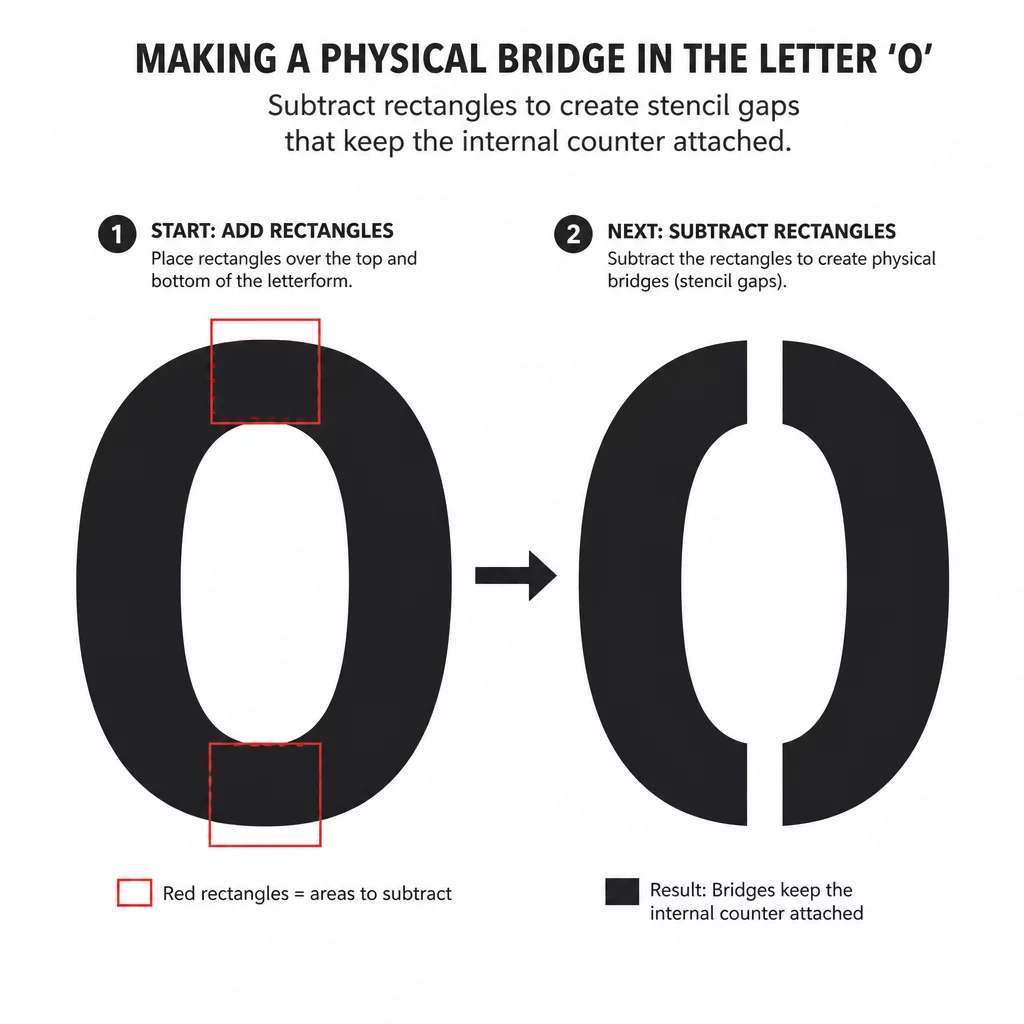
Without an uninterrupted physical connection tethering that enclosed geometry to the main sheet, the counter drops free upon ejection. A stencil bridge is precisely this engineered vector gap: an intentional interruption in the closed boundary that unifies the internal island with the outer backing material into one continuous, structurally cohesive cut-plane.
Key Takeaways
- Enclosed counter shapes (like the center of O, D, and B) lose all support unless bridged to the carrier substrate.
- Bridge width must match substrate tensile strength, blade kerf, and final material scale.
- Boolean subtract operations create clean 90-degree corner anchors that avoid jagged weed tear-out.
02Calculating Structural Bridge Width and Placement
Determining the cross-sectional thickness of a vector bridge requires balancing visual legibility against substrate tear resistance. Choose bridge width by the stencil material, finished size, and intended handling. Inspect the retained connection around each island and compare a physical test with the desired letterform.
A bridge is not a typographic flaw; it is the physical anchor that transforms digital vector glyphs into functional cut components.
Placement strategy is equally critical. Locating bridges along natural vertical stems, horizontal crossbars, or symmetrical quadrant points preserves the glyph's optical recognition while providing maximum mechanical stiffness against lateral blade drag.
03Boolean Subtraction vs Manual Node Splitting Workflow
Two distinct digital methods exist to construct stencil bridges in vector graphics software. While manual knife slicing often introduces micro-gaps and misaligned vertices, boolean subtraction yields clean and mathematically closed path topology.
- Draw rectangular vector bars with exact caliper-measured width across the counter perimeter.
- Execute boolean Subtract or Minus Front to sever the continuous outline in a single deterministic operation.
- Inspect resulting corner nodes to confirm closed continuous paths and eliminate zero-length micro-segments.
Following the boolean operation, verify that the former compound path has been converted into a single unified polygon boundary. This eliminates double-cut passes along the junction lines and ensures smooth machine motion.
04Material Rigidity, Kerf Factors, and Stress Points
Every physical blade possesses a finite cutting width known as kerf, accompanied by an offset swivel radius. When a 45-degree or 60-degree blade navigates the sharp inner corners of a bridge, excessive corner overcut settings can clip into the bridge root, weakening its physical attachment.
Compare sharp and rounded bridge-to-glyph corners at the intended size. This distributes mechanical tension evenly across the boundary and prevents stress concentration during rigorous paint application or repeated handling.